
The Innisfree no. 12: The Second Station

Then they took him away, and, carrying the cross by himself, he went out to what is called the Place of the Skull.
- John 19:16-17
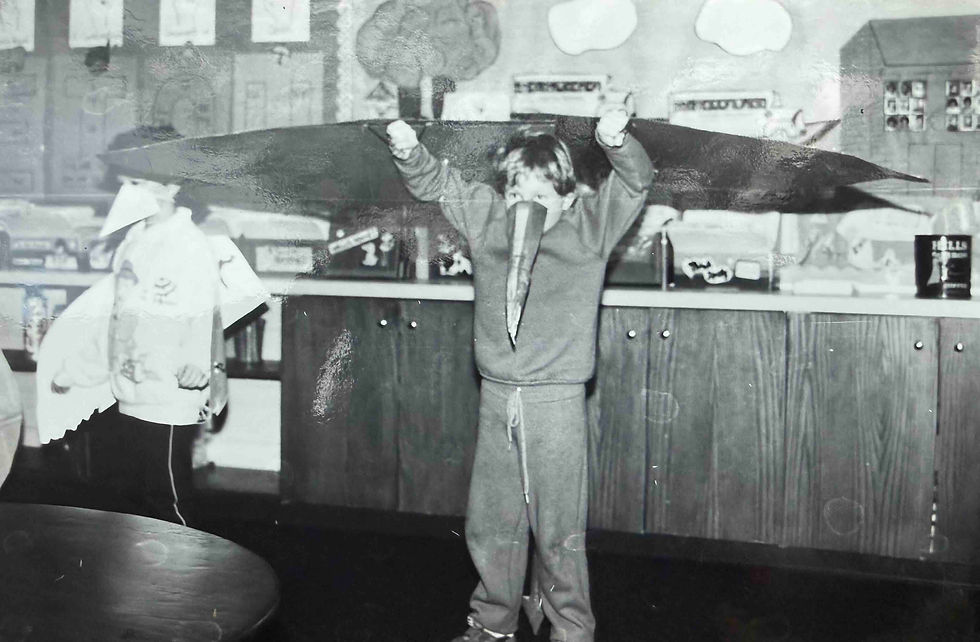
A few years passed, and our pilgrim grew into an inquisitive and precocious child. He excelled at school, in large part because he went to an experimental classroom set-up that allowed him to learn at his own speed, which suited him well. He was disciplined and hard-working and so he had no trouble keeping occupied. It also didn't hurt that he was the only boy in the class, and so, alone and awkward, he was determined to find solace in books, and learning, and fanciful stories.
He started writing his own stories. They were derivative and insular, the sputtering awakening of a child just booting up his life's vocation. He was a maudlin little thing and was drawn to the macabre and the sad. His favorite holiday was Halloween, and during the Autumn he would spend his weekends riding his bike around his neighborhood, the cracked sidewalks, the Queen Annes, the bronze and gold shade of Midwestern Autumn. He listened to The Beach Boys on repeat with his Walkman tape recorder, the wailing of those ancient songsters the perfect timbre for his lovelorn and sullen wanderings.
Often he found himself riding in circles around the hulking and ancient brick edifice of his elementary school, which carried on its face the scars of a century of schooling. He knew where the library was located from the outside of the building, and he'd stop his bike and look up at the windows, dreaming his autumnal dreams. In this season, he could feel most keenly the sweet sting of youth and its ending. He never could have articulated it then, but he could see so much of the pathos of life when he looked up at the windows, the leaves drifting in the breeze slowly to the ground. Life was short. It had barely begun and already he could feel it ending.
He found something like comfort in the fall, maybe because it was a time where death and endings were celebrated, when he wasn't so alone in musing on reapers and graves. The whole world was a graveyard, after-all. Perhaps he thought that in making friends with Death, he might begin to understand and blunt some its great power. Death fascinated him, and so he worried at it, like a scab or a canker sore in his mouth. And he began to assume that he did know something of Death, that he might be able to live with it after-all.
***
So it was, during the summer of our pilgrim's 9th year on this Earth that Death came to him in a form he did not expect. He was away from home at a sleep-away camp in the woods of Western Michigan. It was a sunny and beautiful day. He'd just finished lunch and was heading to the next round of activities, archery or arts and crafts or some such. He had a full belly, and the sun was shining, and he was contented.
As he made his way through the maze of paths and fields toward his destination, he crossed one of the small gravel roads that worked in and out of the camp. On the edge of the road he spotted something, and it caught him short. He went over to look, and found that it was a large Box Turtle lying in the dust. It's shell was cracked down the middle, and blood came from its nose and mixed in the dirt. Its front legs worked, its claws scratching, but the turtle remained where it was. It's back legs didn't move at all.
Our pilgrim was filled with sadness and pity. The turtle looked up at him slowly, and the sun shone bright in its black eyes. The horror of the scene was made even more obscene by the sun-washed clarity of the day. How could something so terrible happen on such a beautiful day? He watched the turtle for a few minutes, horrified by the boldness of Death, until it became clear this poor beast was going to put up a long and wretched fight. Our pilgrim remembered something he'd heard many times in movies and the books he read. He was going to put the creature "out of its misery." He was certain of the rightness of this decision. This was what heroes did.
With no other options available, he went to some nearby shrubs and grabbed the largest rock he could find. He brought the rock back to the turtle, and he raised it above his head, and his arms trembled with the weight of the rock and that which he meant to do. He paused a very long time, unsure now of whether this was the right thing to do or something else entirely. Was he killing the turtle, or was he absolved of its death because of the sheer inevitability of it? He was a good boy and he wanted to do the right thing. As he brought the rock down his heart failed him and he tried to stop himself, but instead the rock tumbled out of his hand and landed on the poor turtle's head. Our pilgrim stood shocked for a moment, and then he moved the rock out of the way, and the turtle lifted it's battered and bleeding head and looked at him. He was horrified by what he'd done, this act of mercy perverted into betrayal and madness. There was blood on the rock. It glistened in the sunlight. The turtle lowered its head in the dust and closed its eyes.
All at once our pilgrim understood something important about Death, something which his ghost stories and autumn musing hadn't prepared him for. It was the utter humiliation of it, the elemental stripping of it. All greatness washed away with the blood, back into the dirt. Death made a mockery of life, with all its glory and beatific distractions, reducing all of life's promises to these few unavoidable moments. He also understood clearly that Death was waiting for him as well, and that there was no amount of bartering or begging that would stay its icy hand. It fell like a weight on his heart, this understanding, and he fell to his knees and cried next to his miserable companion. His tears fell into the dust next to the blood, and the sun burned the back of his neck as he sobbed.
Eventually, he stood and wiped his eyes and nose. He apologized to the turtle, for adding to its pain and for not being strong enough to help, and then he went on his way to the next camp activity. As most do when faced with the inevitability of death, our pilgrim did his best to pretend the opened door in the back of his mind was still closed. But it stood open, its black yawning a reminder of the weight, which all creatures carry, under heaven.
The sun shone all that day. There wasn't a cloud in the sky.


Comments